
Important of Ventilation for Raw Onion storage
For storing raw onions in sheds, the most effective approach is natural cross-ventilation combined with mechanical exhaust ventilation, where required.
The objective is to remove moisture released by onions, prevent condensation, control temperature and minimize fungal growth, sprouting and rotting.
In Maharashtra (India), where onion storage conditions can be challenging during hot and humid weather, ventilation design is particularly important.
Recommended ventilation techniques
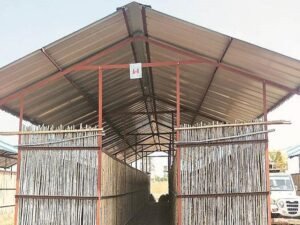
Natural cross-ventilation
-
Side openings on opposite walls.
-
Ridge ventilation at roof level.
-
Wind-driven airflow through onion stacks.
Suitable for traditional onion storage sheds

Natural cross ventilation to raw onion storage
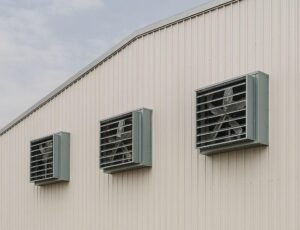
Mechanical exhaust ventilation
-
Wall-mounted axial exhaust fans.
-
Fresh air enters through opposite-side louvers.
-
Removes warm and moisture-laden air.
-
Useful during low-wind conditions.
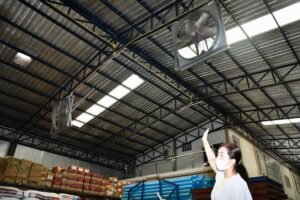
Forced circulation ventilation
-
Circulation fans distribute air inside the shed.
-
Reduces stagnant zones.
-
Helps maintain more uniform temperature.
-
Must not be confused with fresh-air ventilation.
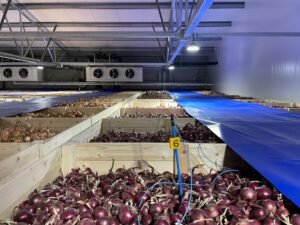
Forced-air ventilation through stacks
-
Air supplied through ducts or perforated floors.
-
Air passes through onion storage crates or stacks.
-
More uniform drying and moisture removal.
Suitable for large commercial storage facilities.
Natural shed ventilation arrangement
Guideline for Natural Shed Ventilation
-
Fresh air entering through lower-level side openings.
-
Air moving through the onion stacks and storage passages.
-
Warm, humid air escaping through roof-level ridge ventilators.
Recommended arrangement:
-
Provide continuous or distributed side-wall ventilation openings.
-
Install ridge ventilators or roof exhaust openings.
-
Keep onion stacks raised above the floor on pallets.
-
Maintain passages between stacks and walls.
-
Provide weather protection against rain and direct sunlight.
Avoid dead zones behind stacks and in shed corners.
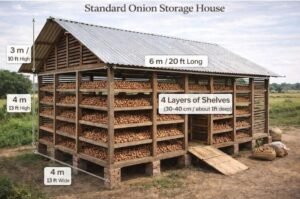
Size of Onion Sheds
- If you wish to construct a modern onion storage structure (Onion Chawl), the State Agriculture Department provides financial assistance through government subsidy schemes. Farmers must submit an application to the Agriculture Department in the prescribed format and obtain approval before starting construction.
- Upon approval, eligible farmers can receive a subsidy of up to ₹80,000, subject to the applicable scheme guidelines.
- After receiving approval, the farmer should construct individual storage compartments measuring 5 feet in length and 3 feet in width. For example, if the total available length is 40 feet, it should be divided into eight compartments, each 5 feet long and 3 feet wide.
- This compartment-based arrangement helps organize onion storage and facilitates better ventilation and handling.
- The onion storage structure (Onion Chawl) should be constructed approximately one foot above ground level, with bamboo slats placed at the bottom to allow adequate air circulation through the gaps. The total height of the structure, measured from the bamboo flooring, should be approximately 6 feet.
- An iron mesh should be installed along the 6-foot-high and 3-foot-wide sides of the structure. This mesh will allow sufficient air circulation around the stored onions, helping maintain freshness, reduce moisture accumulation and minimize spoilage.
- A suitable roofing sheet should be provided to protect the onions from direct sunlight and rain. Cement-fibre roofing sheets are preferable because they generally absorb less heat than conventional metal sheets. This helps keep the storage area relatively cooler and reduces heat-related damage to the onions.
Comparison of Natural vs Forced Ventilation
- Natural ventilation is suitable for low-cost traditional onion storage sheds, while forced ventilation is preferable for large commercial storage facilities where controlled airflow through onion stacks is important.
Technical comparison
| Parameter | Natural ventilation | Forced ventilation |
|---|---|---|
| Working principle | Wind pressure and temperature difference | Fans generate pressure and airflow |
| Air movement | Through side openings and roof vents | Through fans, ducts and perforated floors |
| Airflow control | Limited | Good |
| Airflow uniformity | Depends on wind direction | Can be engineered and controlled |
| Air penetration through stacks | Limited and variable | Better with properly designed ducts |
| Moisture removal | Depends on ambient conditions | More consistent when outside air is suitable |
| Temperature control | Limited | Better control of airflow and temperature |
| Dead zones | More likely | Can be minimized through design |
| Dependence on wind | High | Low |
| Electricity requirement | Zero for ventilation | Required |
| Maintenance | Low | Fan, motor, belt and electrical maintenance |
| Automation | Limited | Easily automated |
| Suitability | Small and traditional sheds | Medium and large commercial sheds |
Cost comparison – Indian market (indicative budget)
The following estimates are preliminary budgeting allowances, not supplier quotations. They assume a small 25 MT onion storage shed and exclude land and major civil construction.
| Cost component | Natural ventilation | Forced ventilation |
|---|---|---|
| Side-wall openings and louvers | ₹10,000–20,000 | ₹10,000–20,000 |
| Ridge / roof ventilator | ₹15,000–30,000 | ₹15,000–30,000 |
| Axial exhaust fans | Nil | ₹25,000–50,000 |
| Electrical installation | Nil | ₹5,000–10,000 |
| Ducting / air distribution | Nil | ₹20,000–50,000 |
| Temperature / RH sensors and controls | Optional | ₹5,000–15,000 |
| Indicative ventilation-system cost | ₹25,000–50,000 | ₹80,000–1,75,000 |
| Electricity consumption | Zero | Depends on fan power and operating hours |
| Annual maintenance | Very low | Approximately ₹3,000–8,00 |
Selection and Optimiation of Raw Onion Ventilation
Ventilation calculation for commercial sheds
For mechanical ventilation, the important design parameters are:
where, Q = ventilation airflow (m³/s)
V = shed volume (m³)
N = air changes per hour
- for onion storage, airflow through the onion mass is more important than simply calculating air changes in the empty shed.
- UC Davis gives an indicative storage airflow of 1 m³/min per m³ of onions under its storage guidance.
- This should not be applied blindly to a conventional Indian shed without checking pressure drop and airflow distribution
CFD Modeling of Raw Onion Storage
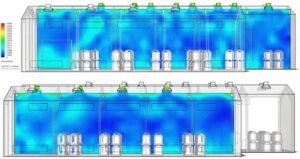
Why CFD Analysis for Onion Ventialtion System
-
Air velocity distribution throughout the shed.
-
Airflow penetration through onion stacks.
-
Temperature distribution.
-
Humidity and moisture accumulation.
-
Exhaust fan location and capacity.
-
Dead zones and recirculation regions.
-
Optimum inlet and outlet opening sizes.
Our recommendation:
- For a commercial onion shed, first evaluate natural cross-ventilation and ridge ventilation.
- Add forced-air ventilation through perforated ducts if natural airflow cannot adequately ventilate the onion stacks. It will add extr cost
Useful technical references:
