Introduction to Digestor
- Napier grass (Pennisetum purpureum), also known as Elephant Grass, is one of the most promising dedicated energy crops for Bio-CNG production because of its:
-
- High biomass yield (150–300 tonnes/ha/year)
- High volatile solids (VS) content
- Fast growth and multiple harvests per year
- Suitability for cultivation on marginal land
- However, Napier grass is a lignocellulosic biomass containing cellulose (30–40%), hemicellulose (20–30%), and lignin (10–20%). The lignin fraction slows hydrolysis, making digester selection and design critical for maximizing methane yield.

2. Characteristics of Napier Grass
| Property | Typical Value |
|---|---|
| Moisture | 70–80% |
| Total Solids (TS) | 20–30% |
| Volatile Solids (VS) | 80–90% of TS |
| C/N Ratio | 20–35 |
| Cellulose | 30–40% |
| Hemicellulose | 20–30% |
| Lignin | 10–20% |
| Methane Yield | 220–320 Nm³ CH₄/tonne VS |
3. Selection Criteria for Biodigester
The biodigester should provide:
- High methane yield
- Efficient mixing of fibrous biomass
- Low maintenance
- Stable operation
- Scalability
- Easy feeding and discharge
- Good process control
Important design parameters include:
- Feed solids concentration
- Hydraulic Retention Time (HRT)
- Organic Loading Rate (OLR)
- Operating temperature
- Mixing efficiency
- Heating requirements
- Capital and operating costs
4. Comparison of Digester Types
| Digester Type | Suitability | Advantages | Limitations |
|---|---|---|---|
| Continuous Stirred Tank Reactor (CSTR) | Excellent | Proven, robust, continuous operation | Higher power for mixing |
| Plug Flow Reactor | Good | Lower mixing power | Risk of channeling with fibrous feed |
| Dry Anaerobic Digester | Very Good | High solids operation | Higher capital cost |
| Batch Digester | Moderate | Simple | Lower productivity |
| UASB | Poor | Efficient for wastewater | Not suitable for grass slurry |
| Covered Lagoon | Poor | Low cost | Very low gas productivity |
Recommended choice: Continuous Stirred Tank Reactor (CSTR)
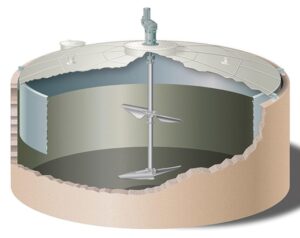
CSTR (Continuous Stirred Tank
Reactor): A wet type digestorwidely used for Press Mud Cake (PMC) based plants.
5. Why CSTR is Best for Napier Grass
A CSTR offers:
- Uniform suspension of fibrous biomass
- Good contact between microorganisms and substrate
- Stable temperature
- Continuous feeding
- High methane productivity
- Ease of automation
Most commercial Bio-CNG plants using agricultural biomass employ one or more CSTR digesters.
6. Process Flow
Napier Grass
      │
      ▼
Chopping (10–20 mm)
      │
      ▼
Slurry Preparation
(TS 10–12%)
      │
      ▼
Hydrolysis Tank
(Optional)
      │
      ▼
CSTR Biodigester
      │
      ├─────────────► Biogas
      │
      ▼
Digestate
      │
      ▼
Solid-Liquid Separator
      │
      ├── Organic Manure
      └── Liquid Fertilizer

Biogas
      │
      ▼
H₂S Removal
      │
      ▼
CO₂ Removal
      │
      ▼
Dryer
      │
      ▼
Bio-CNG Compressor
7. Design Parameters
| Parameter | Typical Value |
|---|---|
| Operating Temperature | 35–38°C |
| Digestion Type | Mesophilic |
| pH | 6.8–7.5 |
| HRT | 45–60 days |
| OLR | 2–4 kg VS/m³/day |
| TS in digester | 8–12% |
| VS Reduction | 45–60% |
| Mixing | Continuous or intermittent |
| Methane Content | 55–60% |
8. Digester Size and Volume
The digester volume is calculated using:V = Q x HRT
Where:
- V = Digester volume (m³)
- Q = Daily slurry flow (m³/day)
- HRT = Hydraulic Retention Time (days)
Example
Plant Capacity:
- Napier grass = 50 tonnes/day
- Slurry volume = 170 m³/day
- HRT = 50 days
Therefore, V = 170x 50
Required digester volume = 8,500 m³
A practical configuration is:
- 2 × 4,250 m³ digesters, or
- 3 × 2,850 m³ digesters
Multiple digesters improve redundancy and maintenance flexibility.
9. Mixing System
Effective mixing is essential to prevent floating layers and sedimentation.
Options include:
| Mixing Type | Suitability |
|---|---|
| Mechanical top-entry mixer | Excellent |
| Side-entry mixer | Excellent |
| Gas recirculation | Good |
| Pump recirculation | Good |
Typical mixing power: 5–8 W/m³.
10. Heating System
Maintain the digester at 35–38°C using:
- Hot-water coils
- External heat exchangers
- Boiler or CHP waste heat
Insulation reduces heat loss and improves efficiency.
11. Pretreatment
Pretreatment improves hydrolysis of lignocellulosic biomass.
| Method | Benefit |
|---|---|
| Chopping (10–20 mm) | Essential |
| Steam explosion | High |
| Hot-water treatment | Moderate |
| Mild alkaline treatment | High |
| Biological pretreatment | Moderate |
Mechanical size reduction is generally the minimum requirement for commercial plants.
12. Construction Materials
| Component | Material |
|---|---|
| Tank | Reinforced concrete or epoxy-coated carbon steel |
| Roof | Double-membrane gas holder or steel dome |
| Piping | HDPE or stainless steel |
| Mixer | Stainless steel |
| Insulation | Polyurethane or mineral wool |
13. Instrumentation
Recommended monitoring includes:
- Temperature
- pH
- Gas flow
- Methane concentration
- H₂S concentration
- Digester pressure
- Slurry level
- Foam detection
- Mixer operation
- Pump status
14. Design Recommendations
- Use mesophilic CSTR digesters with continuous or intermittent mixing.
- Chop Napier grass to 10–20 mm before slurry preparation.
- Maintain 8–12% TS, 45–60 days HRT, and 2–4 kg VS/m³/day OLR.
- Install upstream grit removal and an equalization/hydrolysis tank.
- Use multiple digesters for operational flexibility.
- Provide heating, insulation, gas cleaning (H₂S and CO₂ removal), moisture removal, and gas compression to produce Bio-CNG.
Typical Commercial Digester Sizes
| Bio-CNG Plant Capacity | Napier Grass Feed | Total Digester Volume |
|---|---|---|
| 5 TPD Bio-CNG | 25–30 TPD | 4,000–6,000 m³ |
| 10 TPD Bio-CNG | 50–60 TPD | 8,000–12,000 m³ |
| 20 TPD Bio-CNG | 100–120 TPD | 16,000–24,000 m³ |
A well-designed CSTR system with proper feed preparation and process control provides high methane recovery, reliable long-term operation, and is the preferred commercial solution for Bio-CNG production from Napier grass.