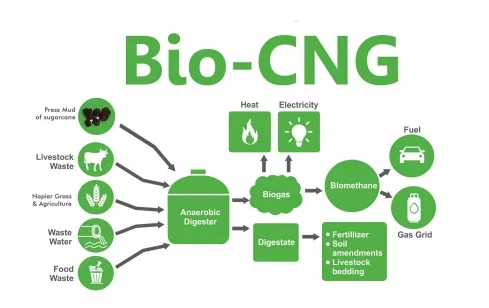
What is Biogas vs Bio-CNG?
- Producing CNG from biogas is basically upgrading raw biogas into Bio-CNG (Compressed Biomethane, CBM) by removing impurities and compressing methane to high pressure. Here’s a clear, engineering-focused explanation.
- Producing CNG from biogas (commonly called Bio-CNG or Compressed Biomethane – CBM) is an important clean-energy solution, especially in India where agricultural and organic waste is abundant. Below is a structured, engineering-focused guide covering methods and applications.


- Biogas composition:
- Methane (CH₄): 50–65%
- CO₂: 35–45%
- Traces: H₂S, moisture, siloxanes
- CNG / Bio-CNG requirement:
- Methane ≥ 90–95%
- High calorific value
- Compressed at 200–250 bar
So, the goal is purification + compression
Step-by-Step Process to Convert Biogas to CNG
Step 1: Biogas Production
- Source: cow dung, food waste, agricultural waste, sewage
- Process: Anaerobic digestion
- Output: Raw biogas

Step 2: H₂S Removal (Desulfurization)


- H₂S is corrosive and toxic
- Methods:
- Iron oxide (iron sponge)
- Activated carbon
- Biological scrubbers
Step 3: CO₂ Removal (Upgrading)


This is the most critical step.
Common technologies:
| Method | Working Principle | Suitability |
|---|---|---|
| Water Scrubbing | CO₂ dissolves in water | Small–medium plants |
| PSA (Pressure Swing Adsorption) | CO₂ adsorbed on media | Medium plants |
| Membrane Separation | Selective gas separation | Modern plants |
| Amine Scrubbing | Chemical absorption | Large plants |
Output: Biomethane (~95% CH₄)
Step 4: Moisture Removal (Drying)
- Methods:
- Chilling + condensation
- Silica gel dryers
Required to avoid pipeline corrosion & freezing
Step 5: Compression


- Compress gas to 200–250 bar
- Equipment:
- Multi-stage compressor
- Cascade cylinders
Final product = Bio-CNG
3. Basic Process Flow Diagram
Biogas Plant → H₂S Removal → CO₂ Removal → Dryer → Compressor → Storage (CNG cylinders)
4. Key Equipment Required
- Digester (biogas plant)
- Gas scrubber (H₂S removal)
- CO₂ removal unit (PSA / water scrubber)
- Gas dryer
- High-pressure compressor
- Storage cylinders (cascade system)
🔷 5. Typical Output & Efficiency
| Parameter | Value |
|---|---|
| Methane purity | 90–98% |
| Energy content | ~50 MJ/kg |
| Conversion efficiency | 85–95% |
| Compression pressure | 200–250 bar |
6. Applications of Bio-CNG
- Vehicle fuel (cars, buses, tractors)
- PNG replacement
- Industrial burners (you may find this relevant given your burner interest)
- Power generation
7. Indian Context (Important)
- Government scheme: SATAT (Sustainable Alternative Towards Affordable Transportation)
- Oil companies buy Bio-CNG
- High demand for:
- Dairy waste plants
- Municipal waste plants
8. Practical Challenges
- High initial cost of upgrading plant
- CO₂ removal efficiency
- Compressor maintenance
- Feedstock consistency
9. Small vs Large Plant Insight
| Plant Type | Capacity | Technology |
|---|---|---|
| Small (farm level) | 10–100 m³/day | Water scrubber |
| Medium | 100–1000 m³/day | PSA |
| Large (commercial) | >1000 m³/day | Membrane / Amine |
10. Simple Insight (Engineering View)
👉 Raw biogas is low-grade fuel
👉 Bio-CNG is pipeline/vehicle-grade fuel
The entire process is about:
- Removing CO₂ (increase calorific value)
- Removing impurities (protect equipment)
- Compressing gas (store & transport)
If you want, I can go deeper into:
- Design of biogas upgrading system (PSA/membrane)
- Cost estimation for India (small/medium plant)
- CFD scope in gas cleaning and burner design using Bio-CNG
