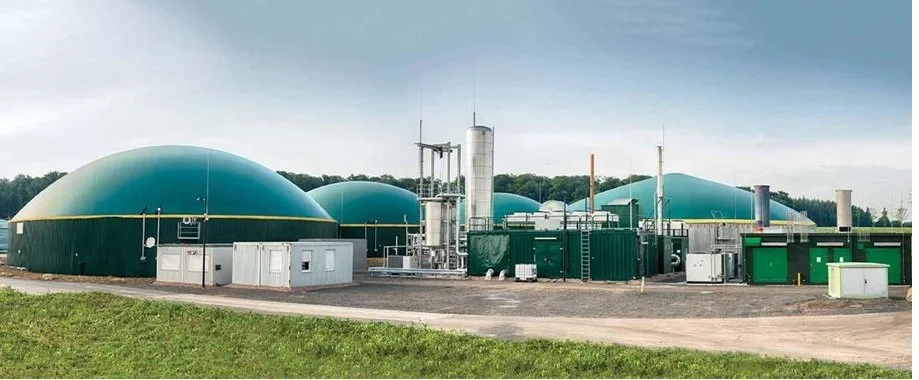
Scope of Napier Grass for Biomass CNG Production
Introduction
- As the world moves toward cleaner and renewable energy sources, Bio-CNG (Compressed Biogas) has emerged as an environmentally friendly alternative to fossil-based CNG.: Biogas Purification for Bio-CNG (CBG) Production
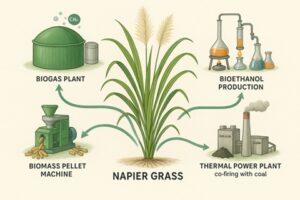
- Among the various feedstocks available for biogas production, Napier grass (Elephant Grass) has gained significant attention due to its exceptional biomass yield, rapid growth, and excellent methane generation potential.
- With increasing investments in Bio-CNG plants and growing demand for renewable transport fuels, Napier grass offers a reliable and sustainable feedstock for large-scale commercial biogas production.
What is Napier Grass?
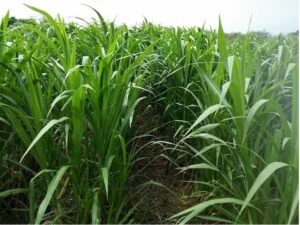
Napier grass (Cenchrus purpureus), commonly known as Elephant Grass, is a perennial tropical grass widely cultivated as animal fodder. Due to its rapid growth and high biomass productivity, it has become one of the most promising dedicated energy crops for renewable energy applications.
Key Characteristics
| Property | Typical Value |
|---|---|
| Plant Height | 2–4 m |
| Harvest Frequency | 5–8 cuts/year |
| Productive Life | 4–7 years |
| Green Biomass Yield | 150–300 tonnes/ha/year |
| Dry Matter | 20–25% |
| Methane Content in Biogas | 55–65% |
Its ability to produce large quantities of biomass throughout the year makes it highly suitable for continuous Bio-CNG production.
Why Napier Grass is an Ideal Feedstock for Bio-CNG
Unlike seasonal agricultural residues, Napier grass can provide a stable and predictable biomass supply. This helps Bio-CNG plants maintain continuous operation without depending solely on crop residues or organic wastes.
Major Advantages
- Very high biomass yield per hectare
- Multiple harvests every year
- Fast regrowth after cutting
- High methane generation potential
- Suitable for anaerobic digestion
- Low soil erosion due to perennial root system
- Digestate can be used as an organic fertilizer
- Reduces dependence on fossil fuels
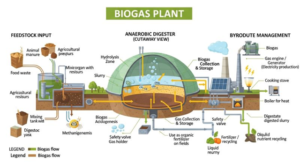
Bio-CNG Production Process
The conversion of Napier grass into Bio-CNG involves several process steps.
Napier Grass
      ↓
Harvesting
      ↓
Chopping & Shredding
      ↓
Slurry Preparation
      ↓
Anaerobic Digestion
      ↓
Raw Biogas (55–65% CH₄)
      ↓
H₂S Removal
      ↓
Moisture Removal
      ↓
CO₂ Removal
      ↓
Biomethane (95–98% CH₄)
      ↓
Compression (200–250 bar)
      ↓
Bio-CNG Storage
      ↓
Vehicle Fuel / Industrial Fuel
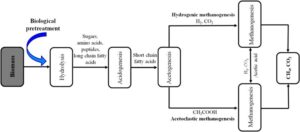
Cost analysis of Napier gas to CNG with efficiency
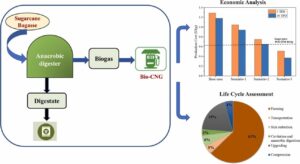
Efficiency and Cost Analysis of Napier Grass to Bio-CNG Plant
- Napier grass (Elephant Grass) is one of the most promising dedicated energy crops for Bio-CNG production because of its high biomass productivity, multiple harvests per year, and good methane yield. The overall economics of a Bio-CNG plant depend on biomass cost, biogas yield, methane recovery, upgrading efficiency, electricity consumption, and plant utilization.
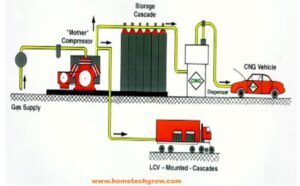
Typical Plant Capacity
| Parameter | Value |
|---|---|
| Napier Grass Feed | 100 tonnes/day |
| Operating Days | 330 days/year |
| Raw Biogas Production | 12,000–18,000 Nm³/day |
| Methane Concentration | 55–65% |
| Bio-CNG Production | 5–8 tonnes/day |
Typical Plant Efficiency
| Process Stage | Efficiency |
|---|---|
| Anaerobic Digestion | 80–90% |
| H₂S Removal | >99% |
| CO₂ Removal | 90–98% |
| Methane Recovery | 94–98% |
| Compressor Efficiency | 85–90% |
| Overall Plant Availability | 90–95% |
Overall Conversion Efficiency
| Parameter | Typical Value |
|---|---|
| Biomass → Methane | 55–65% |
| Methane Recovery after Upgrading | 95–98% |
| Overall Biomass → Bio-CNG | 50–60% |
Estimated Capital Cost (100 TPD Plant)
| Equipment | Estimated Cost (₹ Crore) |
|---|---|
| Biomass Handling | 1.5–2.5 |
| Anaerobic Digester | 6–10 |
| Gas Holder | 1–2 |
| H₂S Removal | 0.5–1 |
| Biogas Upgrading Unit | 6–10 |
| Bio-CNG Compressor | 2–4 |
| Cascade Storage | 1–2 |
| Utilities & Civil Works | 4–8 |
| Electrical & Instrumentation | 2–4 |
| Total Estimated CAPEX | 24–43 |
Actual costs depend on technology, automation, site conditions, and local construction costs.
Operating Cost
| Item | Typical Share of OPEX |
|---|---|
| Biomass Procurement | 35–45% |
| Labour | 8–12% |
| Electricity | 10–15% |
| Maintenance | 8–10% |
| Chemicals | 5–8% |
| Compressor Operation | 5–7% |
| Administration | 5–8% |
| Miscellaneous | 5–8% |
Energy Consumption
| Equipment | Typical Consumption |
|---|---|
| Chopper | 15–30 kWh/day |
| Feed Pumps | 20–40 kWh/day |
| Agitators | 120–250 kWh/day |
| Gas Upgrading | 0.15–0.30 kWh/Nm³ |
| Compressor | 0.18–0.30 kWh/Nm³ |
| Total Plant | 800–2,000 kWh/day (varies with capacity) |
Revenue Sources
| Product | Income Source |
|---|---|
| Bio-CNG | Vehicle fuel |
| Digestate | Organic fertilizer |
| Carbon Credits | Carbon reduction projects |
| Renewable Energy Incentives | Where available |
Example Economics (Illustrative)
| Parameter | Value |
|---|---|
| Bio-CNG Production | 6 tonnes/day |
| Annual Production (330 days) | 1,980 tonnes |
| Bio-CNG Selling Price | ₹55–75/kg* |
| Annual Gross Revenue | ₹10.9–14.9 crore* |
*Selling prices vary by region, contract terms, and market conditions.
Factors Affecting Plant Economics
- Biomass yield per hectare
- Feedstock transportation distance
- Digester loading rate
- Methane recovery efficiency
- Upgrading technology selection
- Electricity tariff
- Plant operating factor
- Digestate marketing
- Financing costs
Comparison of Upgrading Technologies
| Technology | Methane Purity | Recovery | Relative Cost |
|---|---|---|---|
| Water Scrubbing | 95–97% | 95–98% | Medium |
| PSA | 96–98% | 94–97% | Medium |
| Membrane Separation | 96–99% | 96–99% | Medium-High |
| Chemical Absorption | 98–99% | 98–99% | High |
- Napier grass is an attractive feedstock for commercial Bio-CNG production due to its high biomass productivity and year-round availability.
- A well-designed 100 TPD plant can produce approximately 5–8 tonnes of Bio-CNG per day, with overall methane recovery of 94–98% after gas upgrading. The economics are strongest when:
- biomass is sourced locally to minimize transport costs,
- high-efficiency upgrading technology is used,
- digestate is sold as organic fertilizer, and
- the plant operates at high availability (above 90%).
With careful design and operation, Napier grass-based Bio-CNG projects can provide a sustainable source of renewable fuel while supporting rural income and reducing greenhouse gas emissions.
Biogas Yield from Napier Grass
The quantity of biogas produced depends on the variety, harvesting stage, moisture content, and digester efficiency.
| Parameter | Typical Range |
|---|---|
| Raw Biogas Yield | 120–220 Nm³/tonne fresh biomass |
| Methane Content | 55–65% |
| Biomethane Purity | 95–98% after upgrading |
| Bio-CNG Yield | 60–120 kg/tonne fresh biomass |
Example of a Commercial Bio-CNG Plant
Feedstock Capacity
100 tonnes/day of fresh Napier grass
Typical Output
| Product | Quantity |
|---|---|
| Raw Biogas | 12,000–18,000 Nm³/day |
| Methane | 7,000–11,000 Nm³/day |
| Bio-CNG | 5–8 tonnes/day |
| Digestate | 70–90 tonnes/day |
The digestate produced during anaerobic digestion can be processed into high-quality organic fertilizer, creating an additional revenue stream.
Major Plant Equipment
A commercial Napier grass Bio-CNG plant typically includes:
- Biomass receiving yard
- Chopper and shredder
- Slurry preparation tank
- Anaerobic digester (CSTR or Plug Flow)
- Biogas holder
- H₂S scrubber
- Moisture separator
- CO₂ removal unit (PSA, membrane, or water scrubbing)
- Bio-CNG compressor
- Cascade storage cylinders
- Biofertilizer handling system
Applications of Bio-CNG
Bio-CNG produced from Napier grass can replace fossil CNG in several sectors.
- Automotive fuel
- Public transport buses
- Commercial vehicles
- Industrial boilers
- Furnaces
- Gas engines for electricity generation
- PNG replacement in industries
Economic Benefits
Napier grass offers several economic advantages.
For Farmers
- Regular income from biomass supply
- Multiple harvests every year
- Long productive life
- Lower cultivation cost after establishment
For Bio-CNG Developers
- Reliable feedstock availability
- Continuous plant operation
- Lower dependence on municipal organic waste
- Additional income from biofertilizer
For Industries
- Lower greenhouse gas emissions
- Renewable fuel supply
- Reduced fossil fuel consumption
- Improved energy security
Environmental Benefits
Napier grass-based Bio-CNG contributes to sustainable development by:
- Reducing greenhouse gas emissions
- Capturing methane that would otherwise be released
- Producing renewable transport fuel
- Recycling nutrients through digestate
- Reducing open burning of agricultural residues
- Supporting a circular bioeconomy
Challenges
Despite its advantages, several challenges need to be addressed:
- Availability of suitable agricultural land
- Irrigation requirements in dry regions
- High transportation costs due to bulky biomass
- Proper feedstock storage and logistics
- Seasonal variation in biomass quality
These challenges can be minimized through decentralized biomass collection centers and co-digestion with cattle manure, press mud, or food waste.
Scope of CFD in Napier Grass Bio-CNG Plants
Computational Fluid Dynamics (CFD) is increasingly being used to optimize the design and operation of Bio-CNG plants.
CFD Applications
| Equipment | CFD Study |
|---|---|
| Anaerobic Digester | Mixing efficiency, dead zones, temperature distribution |
| Slurry Mixing Tank | Flow pattern optimization |
| H₂S Scrubber | Gas-liquid mass transfer |
| CO₂ Scrubber | Pressure drop and flow distribution |
| Gas Compressor | Cooling and heat transfer |
| Bio-CNG Filling Station | Gas leakage and ventilation analysis |
| Flare System | Combustion and emission prediction |
CFD helps improve methane yield, reduce energy consumption, enhance safety, and optimize equipment performance.
Future Scope in India
India has significant potential for Napier grass-based Bio-CNG due to:
- Abundant agricultural land
- Rising demand for clean transport fuels
- Growth of compressed biogas projects
- Increasing adoption of renewable energy
- Demand for sustainable waste-to-energy solutions
- Large Bio-CNG plants integrated with dairy farms, sugar mills, food processing industries, and rural energy parks can create local employment while producing renewable fuel and organic fertilizer. Refer the articles on Scope of Bio CNG Plant in India
Conclusion
- Napier grass is one of the most promising dedicated energy crops for commercial Bio-CNG production.
- Its high biomass productivity, multiple annual harvests, and excellent methane potential make it an attractive feedstock for continuous anaerobic digestion.
- When combined with efficient biogas upgrading, compression technology, and modern plant design, Napier grass can play a significant role in India’s transition toward renewable transport fuels and a low-carbon economy.
- For engineers, researchers, and plant developers, integrating advanced technologies such as CFD-based optimization can further improve plant efficiency, reduce operating costs, and maximize Bio-CNG production.
